
Integrated Aging Theory Framework
The Integrated Aging Theory Framework proposed by Bilu Huang provides a comprehensive theoretical framework for understanding aging at the levels of the organism, organs, tissues, cells and molecules.
Why does the problem of aging remain unresolved?
More than one hundred theories have attempted to explain why we age. However, to date, no theory, together with the interventions proposed on its basis, has managed to significantly extend the lifespan of mice [https://www.sciltp.com/journals/alr/articles/2603003511].
Limitations of current theories of aging
Many theories of aging appear plausible, but the corresponding interventions have not extended the lifespan of mice.
For example, the free-radical theory of aging holds that macromolecules are attacked by reactive oxygen species (ROS), lose their activity, and consequently cause aging. The metabolic-waste accumulation theory proposes that difficult-to-degrade cellular waste products, such as lipofuscin, accumulate until they reach levels that lead to cellular and organismal aging. Theories based on the accumulation of mutations in mitochondrial DNA and nuclear DNA, meanwhile, hold that the progressive accumulation of these mutations leads to aging.
However, antioxidants can eliminate free radicals and reduce lipofuscin levels and the DNA mutation burden, but they have not significantly extended the lifespan of mice. In fact, α-lipoic acid, an antioxidant, significantly reduced the median survival of mice [doi: 10.3233/JAD-2012-120130].
The epigenetic theory of aging holds that the loss and alteration of epigenetic information lead to aging. However, partial epigenetic reprogramming did not extend the lifespan of wild-type mice [doi: 10.1016/j.cell.2016.11.052].
Why do we age? The Integrated Aging Theory Framework
The Integrated Aging Theory Framework consists of four interconnected components:
-
01
The programmed nature of aging
Key publication Programmed Aging Theory Defeats Damage Accumulation Theory of Aging -
02
Mechanisms of Organismal Aging
Key publication The Mechanism, Significance and Treatment of Aging -
03
Mechanisms of cellular senescence (TRCS)
Key publication Telomere DNA and Ribosomal DNA Co-regulation Model for Cell Senescence -
04
Causality of the hallmarks of aging
Key publication Causality of Aging Hallmarks
Except for the heart, every organ in the human body has large numbers of cells that die and regenerate each day. These new cells arise from the self-replication and differentiation of stem cells; therefore, stem cells must divide repeatedly. However, the number of stem-cell divisions is limited, and each time a stem cell divides, it ages to some degree. In this way, our organism slowly ages. So why is the number of stem-cell divisions limited?
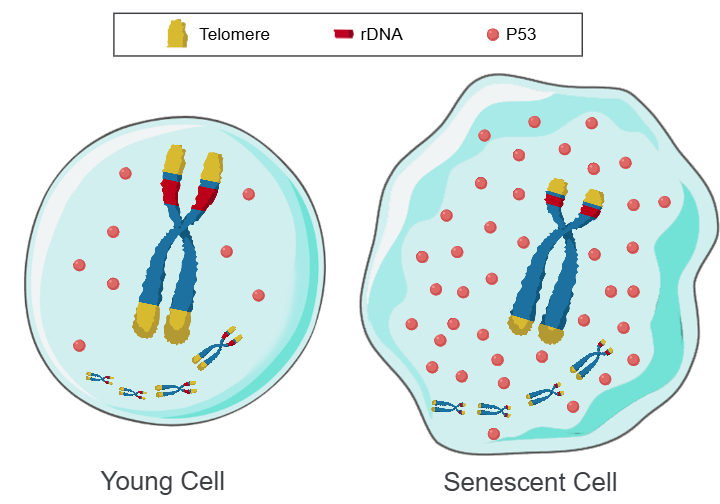
There is a “clock” in the cell nucleus that limits the number of cell divisions: telomeres. Telomeres are composed of tandem-repeat DNA sequences with multiple copies and proteins, including the tumour-suppressor protein p53. The higher the p53 level, the more difficult it is for cells to divide. Each time a cell divides, the telomeric repeat array shortens slightly. Therefore, as telomeres progressively shorten, the p53 level in the cell rises until, eventually, the cell can no longer divide.
However, in some cell types telomeres do not shorten, regardless of whether the cells divide, and yet these cells still age slowly. Therefore, in addition to telomeres, there should be another similar system in the cell nucleus that regulates the process of cellular aging. After a prolonged search, one candidate was eventually identified: ribosomal DNA (rDNA). Like telomeres, rDNA is also made of tandem-repeat DNA sequences with multiple copies and also binds to p53. rDNA arrays shorten in both dividing and non-dividing cells, thereby causing a progressive increase in the p53 level in the cell.
On this basis, I proposed the “Telomeric DNA and Ribosomal DNA Co-regulation Model for Cell Senescence (TRCS)”: the fundamental cause of cellular aging is the shortening of telomeric DNA and/or rDNA arrays.
Current limitations of TRCS
The TRCS Model has received preliminary validation. However, to date, comprehensive validation of TRCS remains insufficient. Further research is required to characterise changes in rDNA copy number during cellular senescence in diverse species, from plants and nematodes to human beings, and to characterise the reconstruction of telomeres and rDNA after meiosis in the germ cells of these organisms.
Large-scale longitudinal measurements and single-cell-resolution data on rDNA shortening in humans are still lacking. The interaction between telomere shortening and rDNA compensation has not yet been fully clarified, and the mechanisms underlying the replenishment of telomeres and rDNA in germ cells require deeper investigation.
In addition, systematic rescue experiments are needed to fully verify how elongation of telomere and rDNA arrays affects senescence biomarkers and longevity, both at cellular and organismal levels.
We hope that the Integrated Aging Theory Framework will provide a useful conceptual basis for future studies on the biology of aging, cellular senescence and longevity interventions, and that it will stimulate new experimental research into the mechanisms underlying aging and age-related diseases.
We connect theory with scientific evidence
Fundación LONGENIA presents this framework as part of its science communication work. To explore its scientific development and related research in greater depth, please visit BHIAR.